Decentralized casinos, ranked by how decentralized they really are
Decentralized casinos · contracts and docs read on 18.09.2026
Plenty of crypto casinos call themselves decentralized. We checked what that means platform by platform: who holds your money, where the bet settles, where the result comes from, whether the contracts are public and who audited them. Six live platforms pass most of those checks. Six popular account casinos pass almost none. Three names from older lists are gone.
Each block is one platform read on 18.09.2026: where it runs, how the outcome is produced, and its decentralization score out of 5. Tapping the stack opens the casino in the card beside it, not the platform named in a block — the six platforms are scored below, in the ranking.
Vave Our pick
150%
on your first deposit
From 20 USDT up to 120,000 USDT
Get the bonus18+ · ×35 wagering · centralized crypto casino · full terms on the casino's site
Most lists of decentralized casinos mix three different things. A few are protocols where the bet really is a transaction between your wallet and a smart contract. More are ordinary crypto casinos with an account, a cashier and a provably fair page. And some are projects that were on-chain once and are now an expired domain. The word on the banner doesn't tell you which is which. The contracts, the docs and the terms do, and they are public.
So on 18 September 2026 we read them. For every platform we wrote down who holds the money, where the bet settles, where the random number or the result comes from, which contract addresses are published and which audit firms are named. We gave one point for each of those five things and half a point where the answer was “partly”. The result is a ranking of decentralized casinos by how decentralized they are, not by how big the bonus is. The method is in how we score.
The most decentralized casinos, in short
- Vave, goes first and outside the score. It is a centralized crypto casino with an account and a crypto cashier, and the only one on this page where we played with our own money.
- Bookmaker.xyz, 4.5/5: an app on the Azuro protocol. Wallet in, wallet out, contract addresses published on four chains and eleven audits listed. Sports and esports only.
- Overtime, 4/5: self-custody on Optimism, Arbitrum and Base, and Chainlink VRF v2.5 behind its twelve casino games. The docs say “audited” without naming the firm.
- SX Bet, 3.5/5: a peer-to-peer betting exchange on its own rollup. Both sides lock collateral in an escrow contract until the match is graded.
- Gamba, 3.5/5: a Solana casino protocol with pools anyone can open. The seed comes from an operator-run RNG provider, which is weaker than an oracle.
- JustBet, 2.5/5: casino games on the WINR Protocol with an on-chain escrow on Arbitrum, but you sign up with email or a social login.
- Dexsport, 2.5/5: an on-chain sportsbook next to 7,500 ordinary casino games, with an internal wallet for people who sign up by email.
-

Vave Our pick
Centralized alternative · account casino · crypto cashier
150%1st deposit
Not decentralized, and it doesn't pretend to be: an ordinary crypto casino with an account and a cashier. It is where we played with our own money: two withdrawals paid, on 28.08 and 02.09.2026, with no documents asked. Bonus 20–120,000 USDT, ×35.
Get 150% -
#1
Bookmaker.xyz Sportsbook app
Polygon · Gnosis · Base · Chiliz · Azuro protocol
4.5/5decentralized
CustodySettlementOutcomeContractsAudits- Wallet in, wallet out: the bet goes from your wallet to Azuro contracts
- Results posted by Data Providers; AzuroDAO arbitrates disputes
- Addresses published per chain; 11 audits listed (Hexens, Pessimistic, HYDN, Pashov and others)
Sports, esports and prediction markets only, no casino games. The most documented protocol on this list.
Go to the site -
#2
Overtime Sportsbook + 12 casino games
Optimism · Arbitrum · Base · own contracts
4/5decentralized
CustodySettlementOutcomeContractsAudits- Self-custody: an EVM wallet or a smart account with social login
- Casino rolls use Chainlink VRF v2.5; winnings claimed on-chain
- Contract source is public (MIT) on GitHub; docs say "audited" without naming the firm
The only live platform here with oracle randomness on its casino games. Unclaimed winnings expire after 90 days.
Go to the site -
#3
SX Bet Betting exchange (P2P)
SX Rollup · own rollup, chain ID 4162
3.5/5decentralized
CustodySettlementOutcomeContractsAudits- A non-custodial proxy wallet per user; MetaMask, Rabby or an email wallet
- Both sides lock collateral in an escrow contract until the match is graded
- Escrow and USDC addresses published; no audit report read
You bet against other players, not a house: 0% maker fee, 1% taker fee on net profit, 5% on parlay profit.
Go to the site -
#4
Gamba Casino protocol
Solana · Solana program
3.5/5decentralized
CustodySettlementOutcomeContractsAudits- Bets go from your Solana wallet into on-chain pools
- Seed from an operator-run RNG provider, plus your client seed and a nonce
- Program ID published; no audit report read
Anyone can open a pool for any SPL token. Front-ends built on Gamba set their own fees.
Go to the site -
#5
JustBet Casino app
Arbitrum · WINR Protocol
2.5/5decentralized
CustodySettlementOutcomeContractsAudits- Sign-up by email or social login; balance held in an on-chain escrow on Arbitrum
- Server seed hashed with SHA-256 and published, plus client seed and nonce
- Bankroll owned by WINR liquidity providers; "audited" escrow, auditor not named
The WINR chip is the betting currency. The protocol caps any single payout at 2% of the bankroll.
Go to the site -
#6
Dexsport Sportsbook + casino
23 networks · own pool + internal wallet
2.5/5decentralized
CustodySettlementOutcomeContractsAudits- Connect a Web3 wallet, or sign up by email or Telegram and get an internal wallet
- Payouts claimed from a liquidity pool; third-party casino games run off-chain
- CertiK and Pessimistic reports linked; DESU token address published
A hybrid: the sportsbook side is on-chain, the 7,500 casino games are ordinary provider slots.
Go to the site
Read on 18.09.2026 from each platform's own app, docs and contracts. The score counts five things, one point each: who holds the money, where the bet settles, whether the outcome can be verified, whether contract addresses are published, and whether audits are named. Half a point where the answer is "partly". It measures decentralization, not payouts or game choice. Vave goes first and is not scored: it is a centralized account casino, so the five checks have nothing to measure on it. Every Go to the site button opens the same casino — the one on the first card — and none of them opens the platform named beside it.
What “decentralized” means on this page
A casino can be decentralized in five places, and they don't come as a package. A platform can put settlement on-chain and still hold your balance. It can publish a provably fair system and run everything else on its own servers. So we check each place separately.
Custody. Where your money sits between bets. In a wallet you control, it moves only when you sign. In an account, it sits in the operator's wallets and moves when the operator decides. This is the check that matters most, and it has its own page: who holds the money.
Settlement. Whether the bet and its payout are transactions in a smart contract, or rows in a database. On-chain settlement means anyone can look the bet up in a block explorer. More in on-chain settlement.
Outcome. Where the random number or the sports result comes from. The strongest answer is an oracle such as Chainlink VRF, which delivers a random number with a proof the contract checks. Next is a commit-reveal seed: the operator publishes a hash first and the seed later. For sports, it is the data source and the dispute process. See where randomness comes from.
Contracts. Whether the platform publishes the addresses of the contracts that hold and move money, so you can check you are talking to the real thing.
Audits. Whether an outside firm reviewed the code, and whether the platform names that firm and publishes the report. “Audited” with no name earns half a point. Why that matters is in smart contract audits.
The score measures decentralization. It says nothing about how fast a platform pays, how many games it has or whether you will like it. A 2.5 can be a perfectly good place to bet; it just asks you to trust the operator in more places.
Six decentralized casinos, one by one
Bookmaker.xyz on the Azuro protocol: 4.5/5
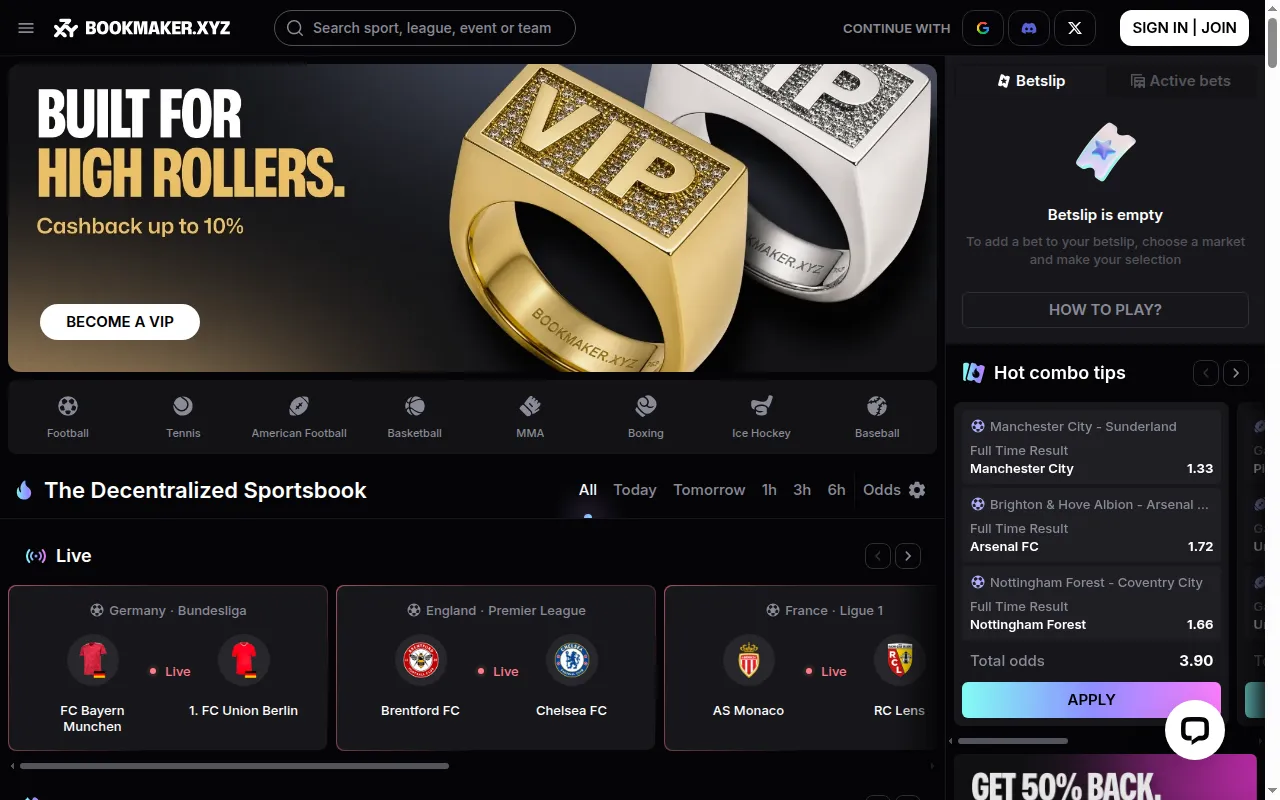
Bookmaker.xyz is a sportsbook app. Underneath it is Azuro, a betting protocol that several apps share. You connect a wallet, place a bet, and the stake goes from your wallet into Azuro's contracts; a win is paid back to the wallet. Azuro publishes the addresses of its liquidity pool, vault and bet contracts for each chain it runs on: Polygon, Gnosis, Base and Chiliz. On Polygon the bet token is USDT.
Liquidity comes from a single pool that takes the other side of every bet. Revenue is split three ways by the protocol: 70% to apps like Bookmaker.xyz, 20% to liquidity providers and 10% to the data providers that post odds and results. That last part is where Azuro loses half a point. Results come from permissioned data providers who resolve markets “in good faith”, with AzuroDAO acting as arbiter in a dispute. It is a documented process, not a cryptographic proof.
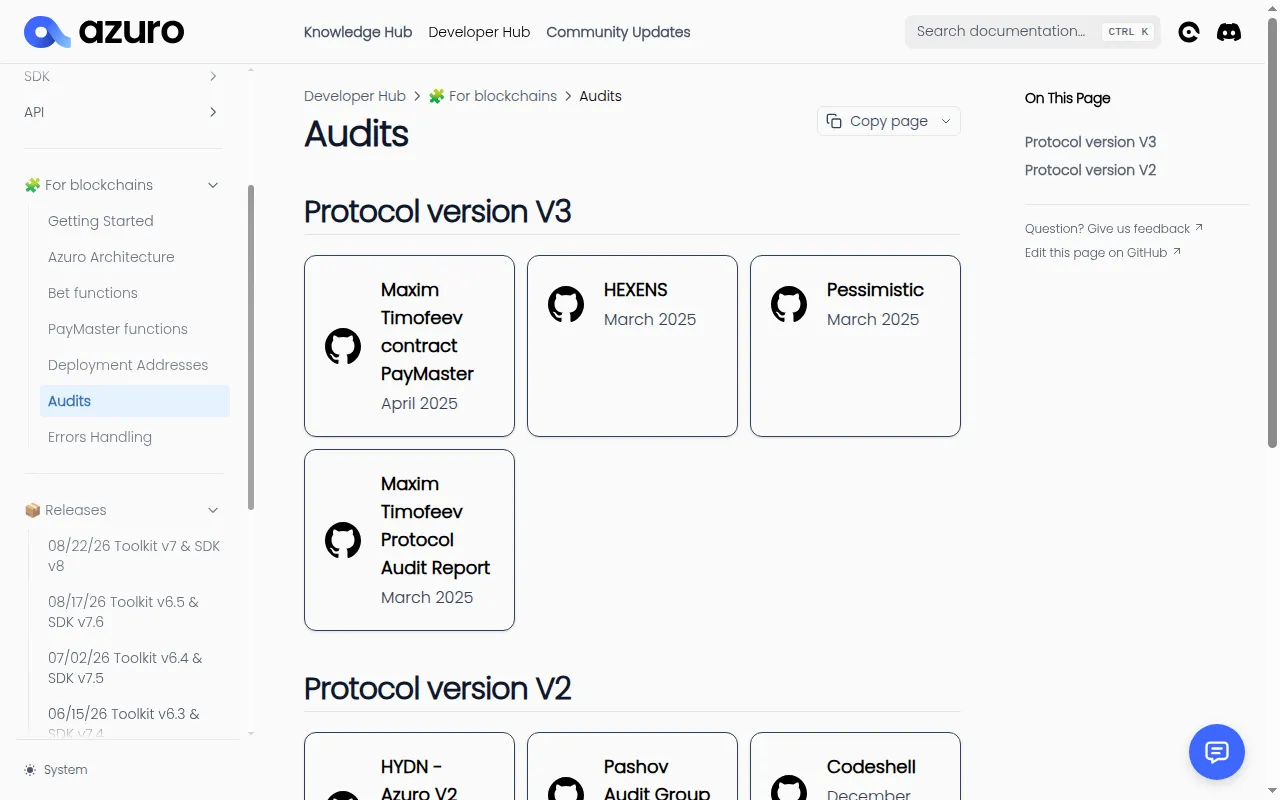
Where Azuro is ahead of everything else here is audits. Its developer hub lists eleven: Hexens, Pessimistic and Maxim Timofeev on version 3 in 2025, and HYDN, Pashov Audit Group, Codeshell, g0 group and Pessimistic again on version 2. The limitation for a casino player is simple: there are no casino games. It is sports, esports and prediction markets.
Overtime: 4/5
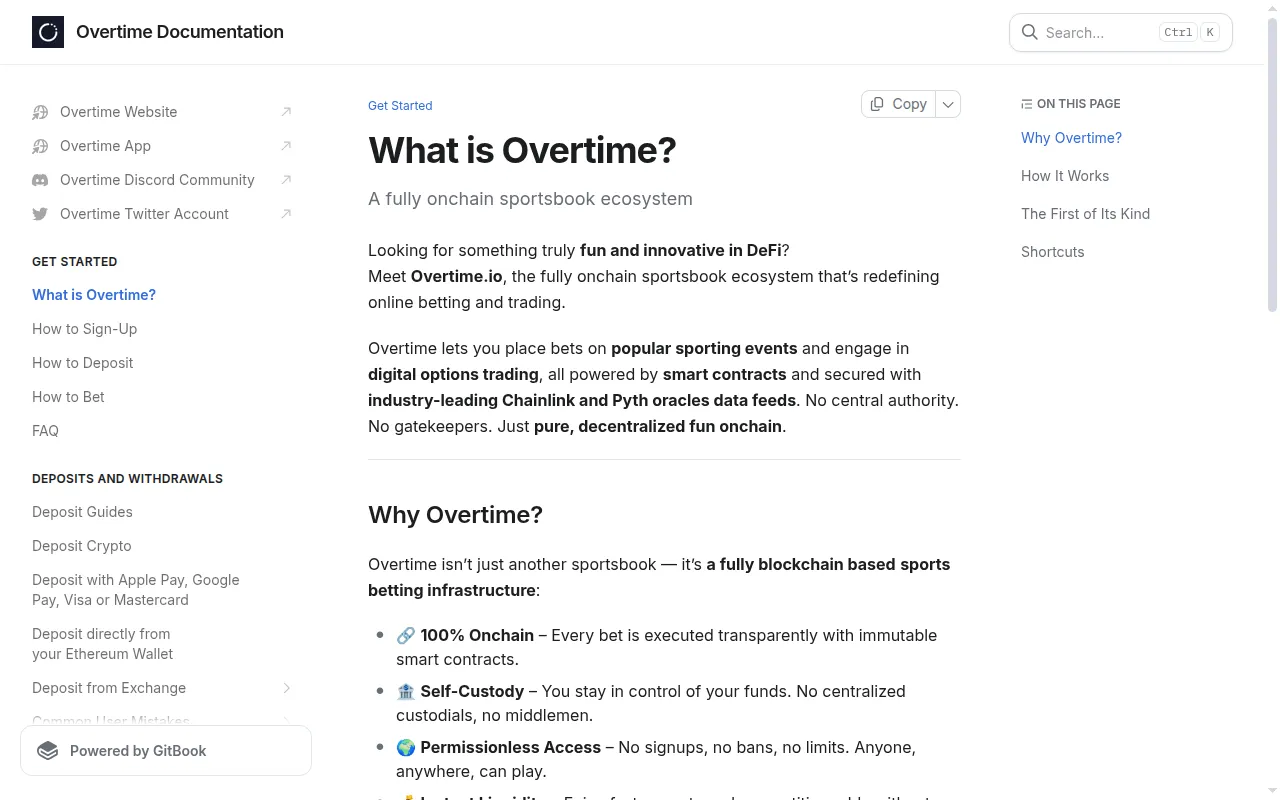
Overtime began as Overtime Markets on the Thales protocol and now runs a sportsbook and twelve casino games on Optimism, Arbitrum and Base. You play from an EVM wallet or from an Overtime Account, a smart account you open with a social login; in both cases the funds are yours, not Overtime's. Its docs describe every bet as a transaction on an immutable contract.
It is the only live platform on this page whose casino games use Chainlink VRF v2.5 for randomness, including staged VRF for card games. The sportsbook takes a 2% protocol fee, and the casino caps its house edge, at 5% for dice and slots. Collateral can be USDC, WETH or its OVER token, with a $3 minimum casino bet, and there is no identity check at protocol level.
Two things keep it from a higher score. The casino contracts are published as source code on GitHub under an MIT licence rather than as a list of deployed addresses. And the docs say each game is “a separate, audited smart contract” without naming the auditor. One rule to know before you play: winnings not claimed within 90 days of a market being resolved are forfeit.
SX Bet: 3.5/5
SX Bet is a betting exchange, not a casino. There is no house. You either post an order (a maker) or take someone else's (a taker), and both sides lock their stake in an escrow contract for that match. When the match is graded, the contract pays the winner. Fees reflect that: 0% for makers, 1% of net profit for takers, 5% of profit on parlays.
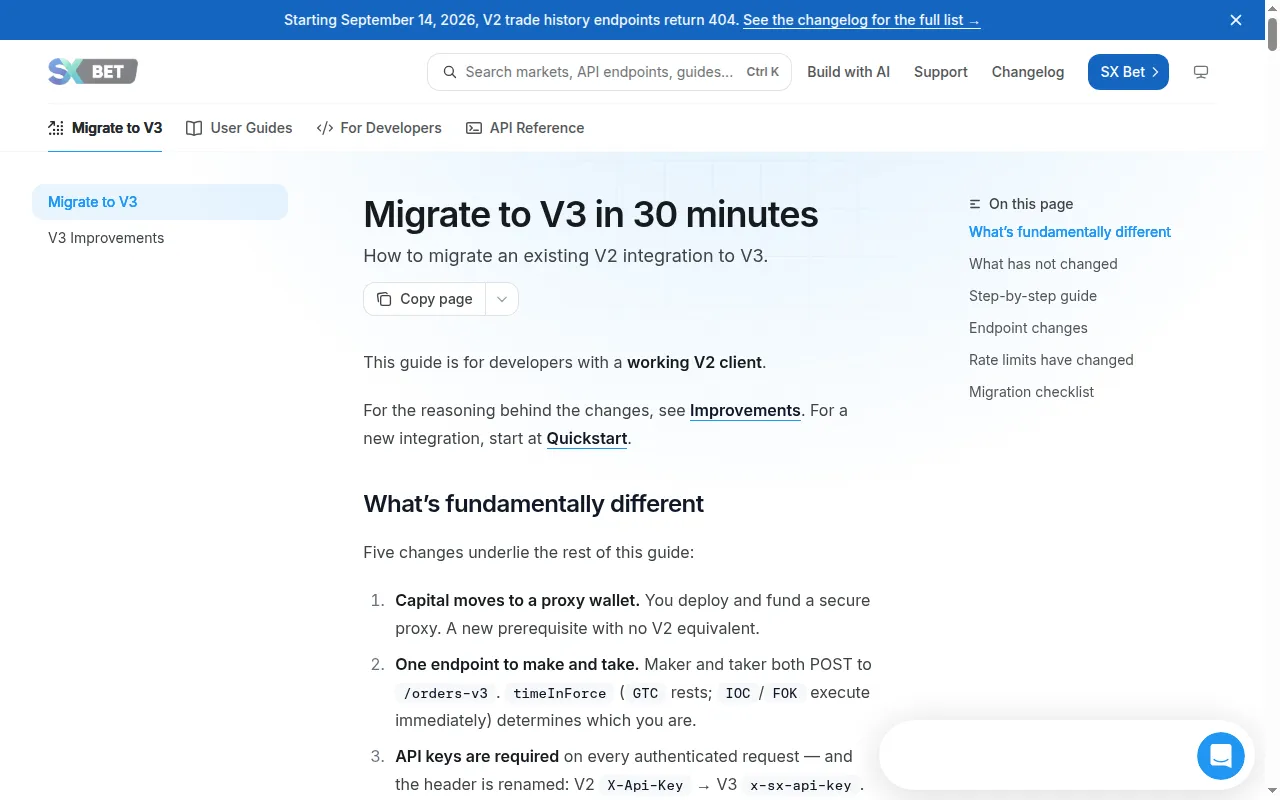
Since version 3, each user gets a proxy wallet, a smart contract under their control. You can open it with MetaMask or Rabby, or with an email or Google login through Magic. Everything runs on SX's own rollup, chain 4162, and the escrow and USDC contract addresses are in the docs. We found no audit report to point to, which costs the full audit point.
Gamba: 3.5/5
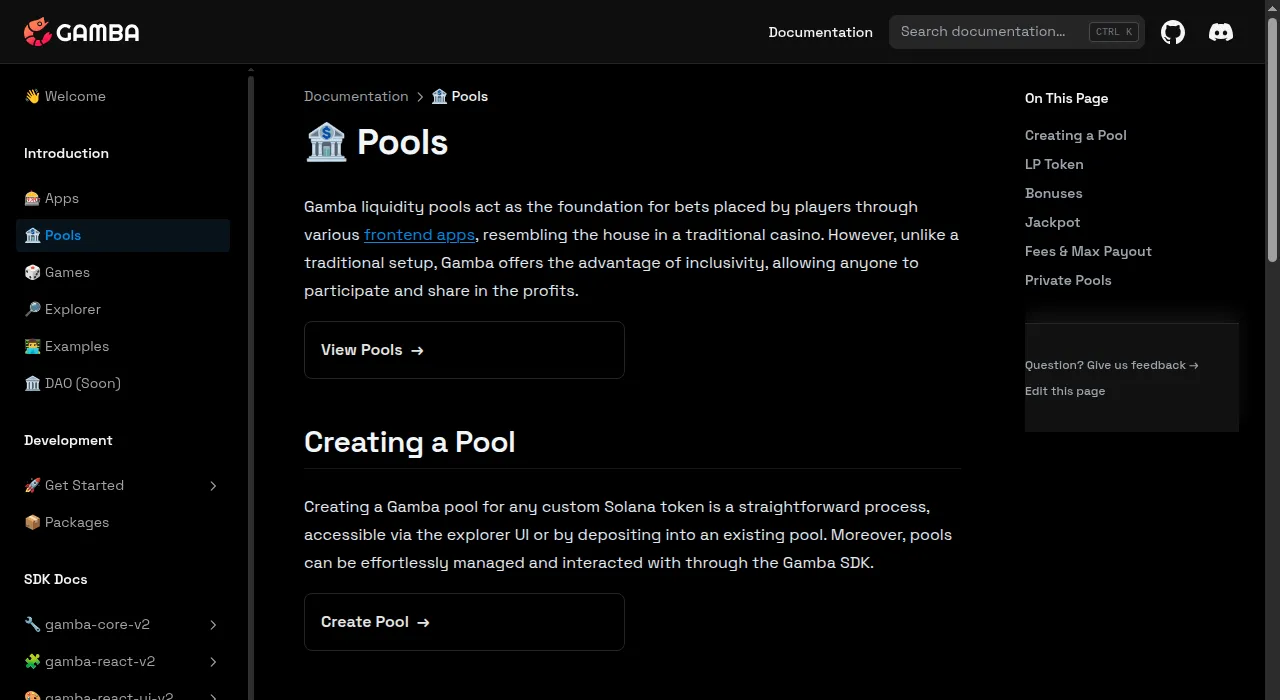
Gamba is a casino protocol on Solana. Players bet from a Solana wallet against liquidity pools, and anyone can open a pool for any SPL token; front-ends built on the protocol earn fees on the bets they bring. The program ID is published, so you can check which program a site is actually calling.
Gamba loses half a point on randomness. Its seed comes from a “Gamba RNG Provider” run by the operator, combined with your client seed and a nonce. That is commit-reveal, like a provably fair casino, and it can be checked after the fact. An oracle such as VRF removes the operator from the loop entirely. No audit report was listed in the docs we read.
JustBet on the WINR Protocol: 2.5/5
WINR is a protocol that runs a shared on-chain bankroll on Arbitrum. Liquidity providers own it; games pay from it and into it, and results settle in epochs of about five minutes. The protocol's risk rules are unusually specific. No single payout can exceed 2% of the bankroll, a 3% loss in a day triggers a cap, and a 10% drawdown switches the bankroll to withdrawals only.
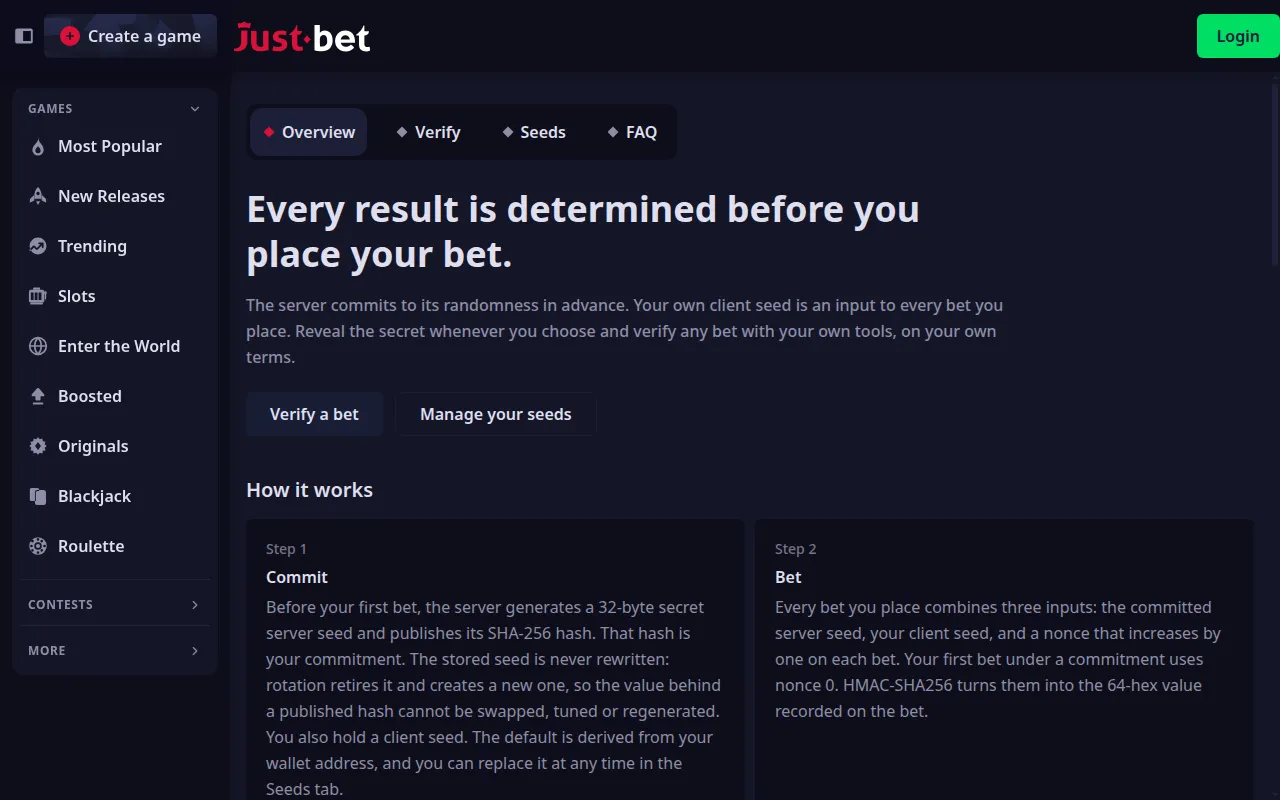
JustBet is the casino app on top, and it looks like any other casino. You sign up with email or a social login. Your balance is held “in on-chain escrow on Arbitrum”, and results use a committed server seed hashed with SHA-256, your client seed and a nonce. Two half points: custody is an escrow tied to an account rather than your own wallet, and the escrow is described as audited with no auditor named. The betting chip is the WINR token itself.
Dexsport: 2.5/5
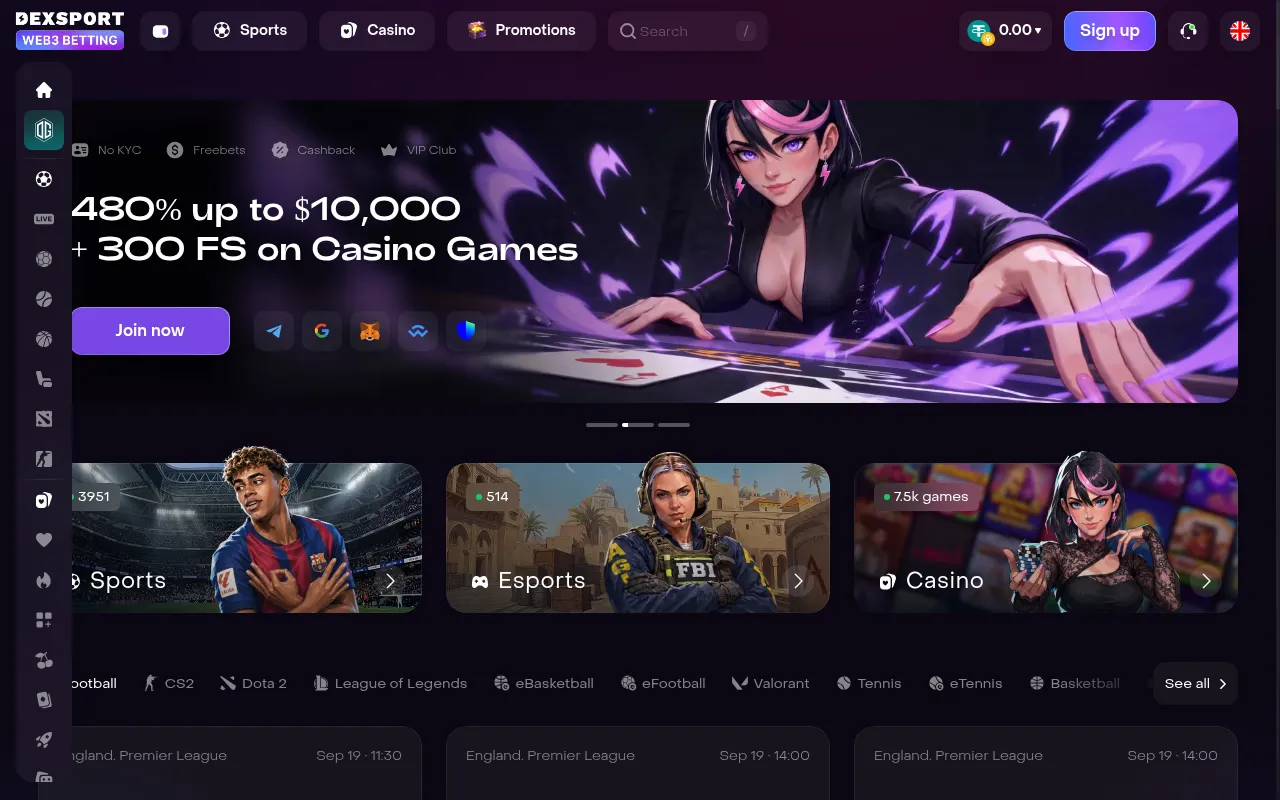
Dexsport is a hybrid. The sportsbook pays out from a shared liquidity pool on-chain, and you can connect a Web3 wallet on any of 23 networks, from Solana and BNB Chain to TON and Tron. But you can also sign up by email or Telegram, which gives you an internal wallet held by Dexsport. And the casino side, about 7,500 games, is ordinary provider slots and live tables running off-chain.
It does well on audits: it links reports from CertiK and Pessimistic. The company behind it, Dexapp LTD, lists an Anjouan licence on its help pages. Its randomness for casino games is the providers' own, which you can't check yourself.
Account casinos that often get called decentralized
Search for decentralized casinos and a lot of the results are big crypto casinos. They take crypto, some have tokens, several have provably fair originals. None of them lets you keep your money in your own wallet while you play. Here is what we found on each.
BC.Game Account casino
0.5/5decentralized
CustodySettlementOutcomeContractsAuditsOne operator wallet across casino and sportsbook. Its crash game runs on a chain of 10 million pre-generated SHA-256 hashes you can check afterwards.
Shuffle Account casino
0.5/5decentralized
CustodySettlementOutcomeContractsAuditsAccount balance after email verification. Seeds are HMAC-SHA256 with a hashed server seed; the SHFL token can be withdrawn to your own wallet.
Stake Account casino
0.5/5decentralized
CustodySettlementOutcomeContractsAuditsDeposits go to a Stake address and sit in an account wallet. Provable fairness is claimed for Stake Originals. The FBI attributed a ~$41M hot-wallet theft on 4 Sep 2023 to Lazarus Group.
Sportbet.one Account casino
0.5/5decentralized
CustodySettlementOutcomeContractsAuditsStarted on EOS, now an ordinary crypto account with email or social login and 18 coins. Provably fair on some casino games.
TG.Casino Account casino
0/5decentralized
CustodySettlementOutcomeContractsAuditsA balance the operator credits and debits, played through Telegram. The TGC token pays stakers a share of profit; the game itself is not on-chain.
CoinPoker Account casino
0/5decentralized
CustodySettlementOutcomeContractsAuditsSays it keeps player funds in secure custody. Cards are shuffled by a certified RNG (Fisher-Yates), which you cannot verify yourself.
The half point most of them get is for a provably fair system. That is worth something: you can take the server seed after a round, hash it, and check it matches what was shown before you bet. But it proves the result wasn't changed after your bet. It doesn't prove anything about where your balance is or whether you can withdraw it.
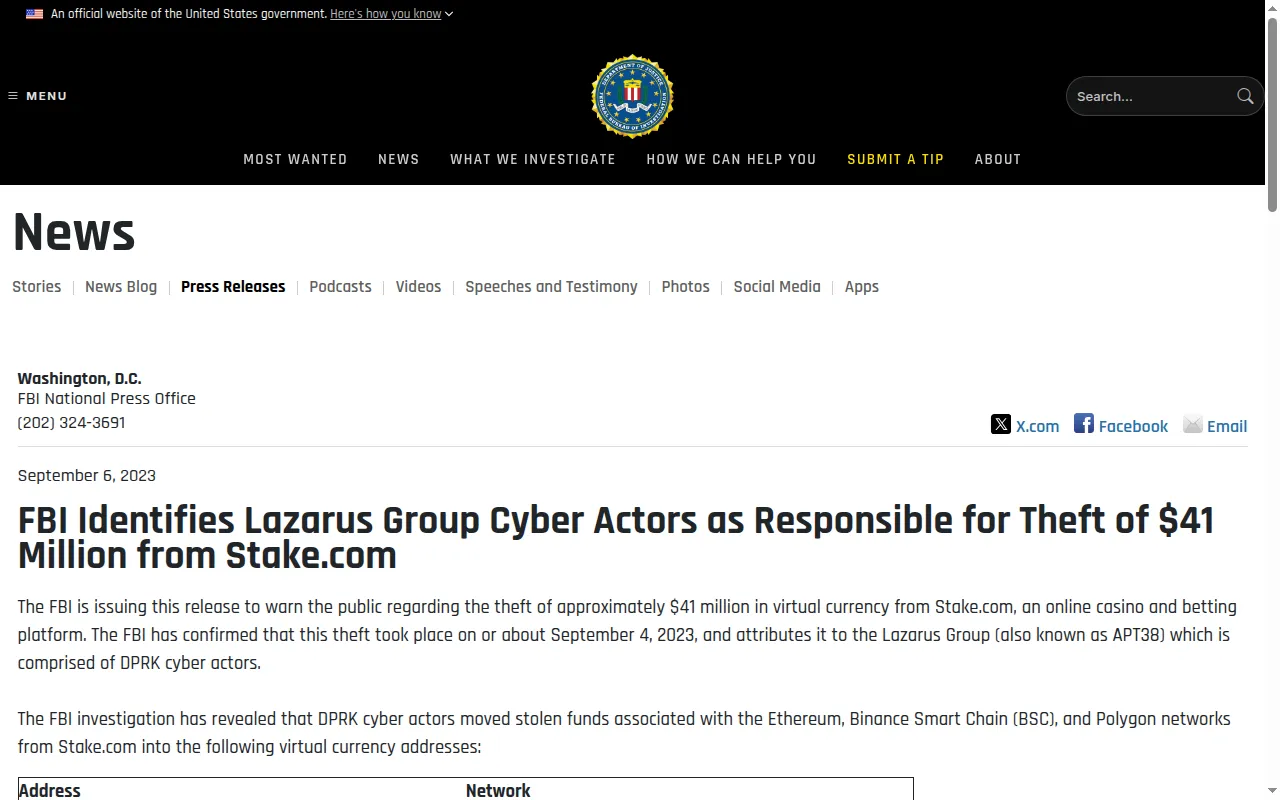
The clearest example of why custody matters is not a small casino. On or about 4 September 2023 about $41M was taken from Stake's hot wallets on Ethereum, BNB Smart Chain and Polygon. The FBI attributed it to Lazarus Group two days later. What it shows is where the money was: in the operator's wallets, on the operator's keys. The comparison in full is on decentralized vs custodial.
All twelve on the same five checks
| Platform | Custody | Settlement | Outcome | Contracts | Audits | Score |
|---|---|---|---|---|---|---|
| Bookmaker.xyz | Yes | Yes | Partly | Yes | Yes | 4.5/5 |
| Overtime | Yes | Yes | Yes | Partly | Partly | 4/5 |
| SX Bet | Yes | Yes | Partly | Yes | No | 3.5/5 |
| Gamba | Yes | Yes | Partly | Yes | No | 3.5/5 |
| JustBet | Partly | Yes | Partly | No | Partly | 2.5/5 |
| Dexsport | Partly | Partly | No | Partly | Yes | 2.5/5 |
| BC.Game | No | No | Partly | No | No | 0.5/5 |
| Shuffle | No | No | Partly | No | No | 0.5/5 |
| Stake | No | No | Partly | No | No | 0.5/5 |
| Sportbet.one | No | No | Partly | No | No | 0.5/5 |
| TG.Casino | No | No | No | No | No | 0/5 |
| CoinPoker | No | No | No | No | No | 0/5 |
Read across a row and you see where each platform asks you to trust someone. Read down a column and you see which checks the market mostly fails. Audits are the weakest column: only Azuro and Dexsport name the firms. Contracts come next; several platforms that say “on-chain” never tell you which contract.
Decentralized casinos that are no longer live
BetSwirl no longer live
Fully on-chain dice, roulette and plinko on five chains with Chainlink VRF. The domain shows a registrar's "expired" page; the last Dice bets we found were on 20–22 March 2026, and VRF fees were withdrawn on 11 May 2026. No statement from the team.
ZKasino no longer live
Took about $33M of bridged ETH from more than 10,000 users, converted it to its ZKAS token and sent it to Lido (CoinDesk, 22 April 2024); later opened a 72-hour window to take ETH back (CoinDesk, 29 May 2024).
Chancer no longer live
The domain shows a website-builder placeholder. Nothing left to check.
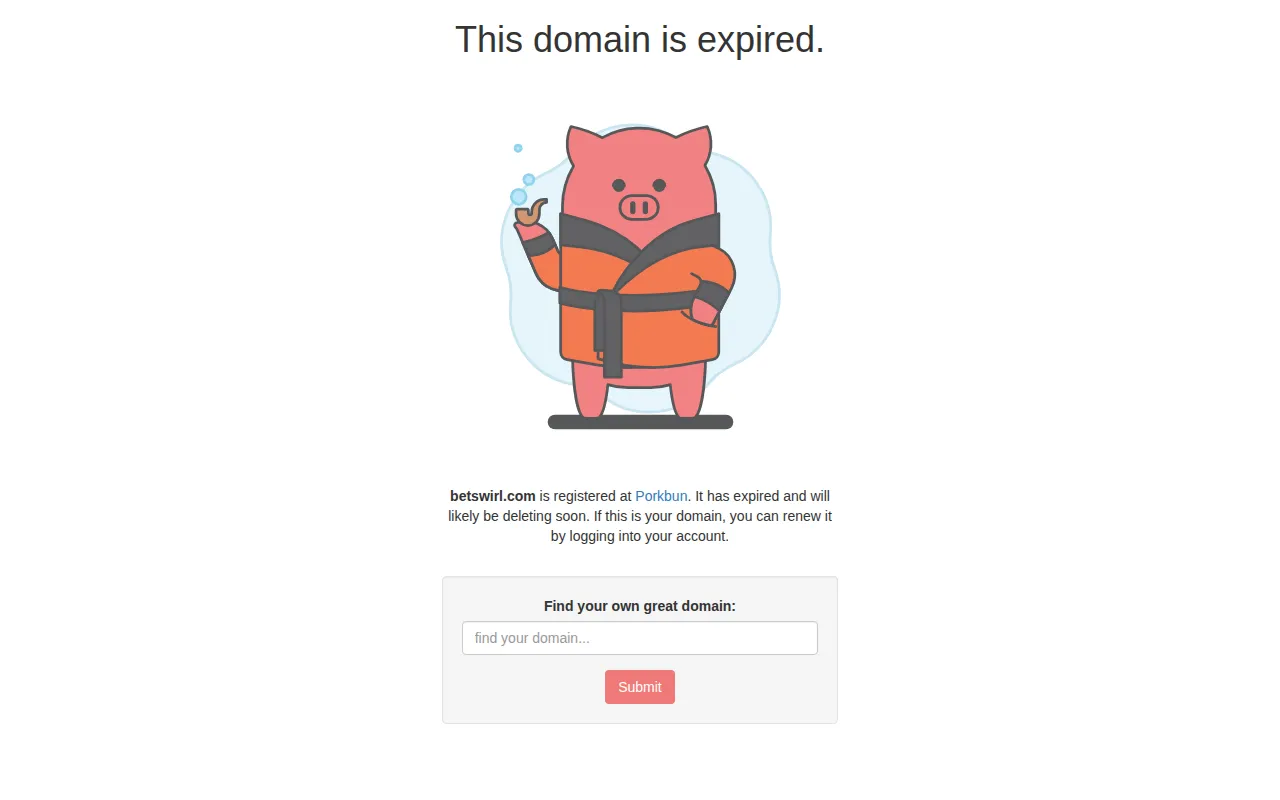
BetSwirl deserves a note, because it was one of the cleanest examples of a fully on-chain casino. Its dice, coin toss, roulette, keno, wheel and plinko ran in contracts on Arbitrum, Avalanche, Polygon, BNB Chain and Base, with a shared bank contract per chain and Chainlink VRF for every roll. On 18 September 2026 its domain showed a registrar's expired page. On the explorers, the last Dice bets we found were on 20 to 22 March 2026. On 11 May 2026 the operator withdrew the VRF fees from the Dice contract on three chains. We found no statement from the team. The contracts are still there; the app is not. What went wrong at ZKasino, and what that means for bridging to a casino's own chain, is on what went wrong.
What a bet looks like on-chain
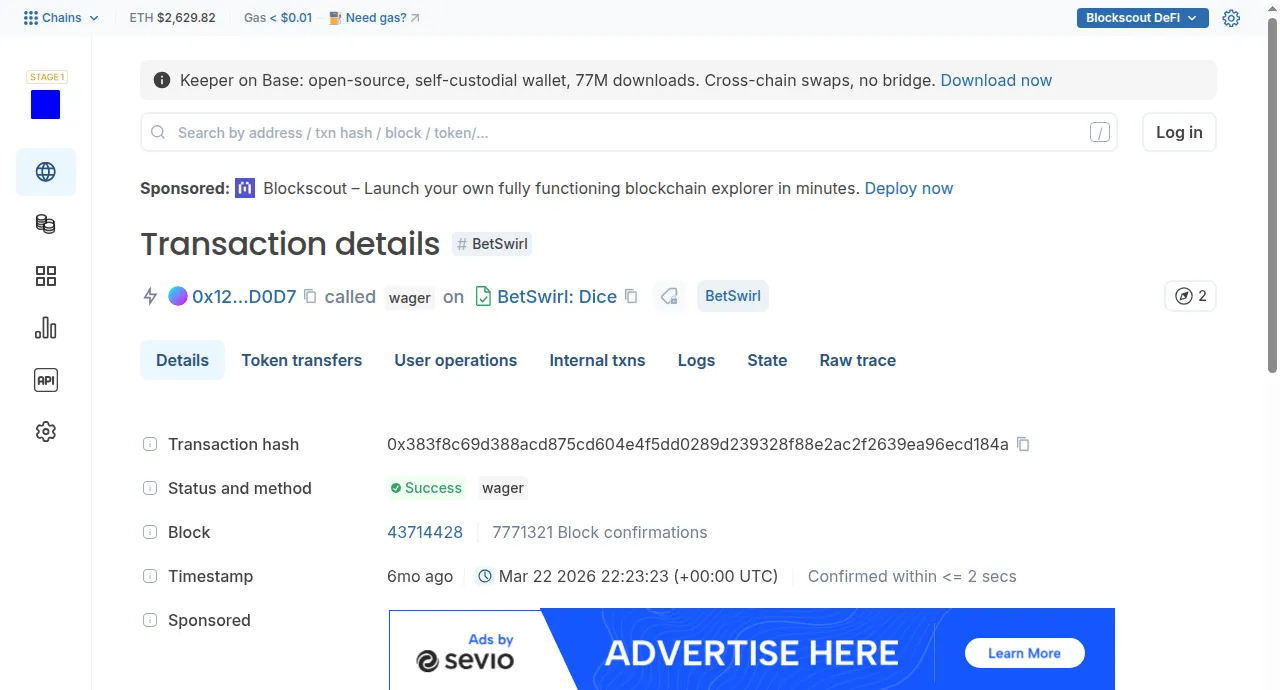
The picture above is one Dice bet on Base, placed on 22 March 2026. It came from a wallet, called the wager function of the Dice contract and landed in its own block. It used 403,875 gas and paid a fee of 0.0000024 ETH. Anyone can open it in a block explorer and see the amount, the contract, the time and whether it succeeded. That is the practical meaning of on-chain settlement: a record neither side can edit.
It also shows the costs you don't see at an account casino. Every bet is a transaction, so every bet pays gas in the chain's own coin, on top of the house edge. On a layer 2 like Base or Arbitrum that is a fraction of a cent. On Ethereum mainnet it would make small bets pointless, which is why none of the live platforms here run games there.
Wallet or account: which kind suits you
Decentralized casinos suit someone who already keeps crypto in a self-custody wallet, is comfortable signing transactions, and would rather carry contract risk than operator risk. You can stop at any time and your balance is where it was. You can look up every bet. You don't send documents to anyone. You also approve token allowances, pay gas and have nobody to call if you send funds to the wrong chain.
An account casino suits someone who wants a cashier, a support chat, fast small bets with no gas, a large game library and bonuses. You give up custody while your money is on the site, and the operator can ask for documents before paying out, as its terms allow. If you pick an account casino, pick one that says clearly in its terms when it can ask for documents, and keep only what you are playing with on the site.
Some platforms sit in between. JustBet and Dexsport let you sign up like a normal casino and keep part of the machinery on-chain. That is fine, as long as you know which part.
The costs, side by side
A decentralized casino and an account casino charge you in different places.
| Cost | On-chain platform | Account casino |
|---|---|---|
| House edge or margin | Yes; Overtime caps casino edge at 5% on dice and slots | Yes, per game |
| Platform fee | Overtime 2% protocol fee; SX Bet 1% taker fee on net profit | Usually none |
| Gas per bet | Yes, in the chain's own coin | No |
| Deposit and withdrawal | Your own wallet transfers; bridge fees if you change chain | Network fee on the way in and out |
| Token exposure | Sometimes: WINR is JustBet's betting chip | Only if you choose to hold the casino's token |
None of these platforms changes the basic maths. Over enough bets, the edge wins. The safe way to play either kind is in safe play on-chain.
Vave, the centralized alternative
You open an account with an email and password, deposit crypto to an address the cashier gives you, and play from a balance Vave holds. None of the five checks on this page apply to it, so it has no score here.
Why feature it on a site about decentralized casinos? Because for many players the honest comparison is between an on-chain platform and a well-run account casino, and Vave is the one we have tested with our own money. We deposited in crypto and made two withdrawals, paid on 28 August and 2 September 2026, and Vave did not ask for documents either time. Its licence is a Curaçao licence held by Latcas B.V.; the certificate names the domain vavegame.com rather than vave.com, which we point out in the review. The welcome bonus is 150% on the first deposit, from 20 USDT up to 120,000 USDT, with ×35 wagering on the bonus.

Everything we read in its terms, including the clause that lets it ask for documents before any payout, is in the Vave review.
Playing on a decentralized casino without getting burned
Most losses on on-chain platforms have nothing to do with the house edge. They come from signing the wrong thing, bridging to the wrong place or trusting a project that disappears. A few habits cover most of it.
- Use a separate wallet for betting. Move in only what you plan to play with. If something goes wrong with an approval, your savings are not in the same wallet.
- Check the contract. Compare the address in the transaction you are about to sign with the one the platform publishes. Bookmaker.xyz, SX Bet and Gamba publish theirs.
- Approve exact amounts. When a site asks to spend your USDC, approve the amount you plan to bet, not “unlimited”. Revoke approvals you no longer need.
- Avoid one-way bridges. A casino's own chain with a single bridge is only as good as the bridge's exit. ZKasino is the example.
- Set a budget before you connect. On-chain betting is fast and there is no cashier to slow you down. Decide the amount first.
The long version, with limits and warning signs, is on safe play on-chain.
How the score works
Each of the decentralized casinos gets up to five points, one for each check: custody, settlement, outcome, contracts and audits. A full point means the answer is yes and we could read it in the platform's own docs, app or contracts. Half a point means “partly”: custody in an escrow tied to an account, a commit-reveal seed instead of an oracle, source code instead of deployed addresses, “audited” without a named firm. Zero means no, or not published anywhere we could read.
We read everything from our own server in the Netherlands on 18 September 2026, without connecting a wallet. Where a page was blocked, as Fairspin's and Rollbit's were, we didn't score the platform. Where a fact couldn't be confirmed, it counts as not published. The details are on how we score.
Which of the decentralized casinos fits which player
If you bet on sports and want the most on-chain setup: Bookmaker.xyz on Azuro, or SX Bet if you want to set your own odds against other players.
If you want casino games with a verifiable random number: Overtime is the only live one here with Chainlink VRF behind its casino. Dice, roulette, blackjack, baccarat, slots, plinko, keno, HI-LO and four poker variants.
If you are on Solana: Gamba-based sites, with the caveat about the RNG provider.
If you want a normal casino library with some on-chain parts: Dexsport or JustBet, knowing that sign-up by email means the platform holds more than it would if you connected a wallet.
If you want an account, a cashier and a bonus: Vave with the caveats in its review.
Five questions to ask any of the decentralized casinos you find
New decentralized casinos appear every month, and most won't be on this page yet. You don't need our score to judge one. Five questions, answered from the platform's own docs, get you most of the way.
- Where is my money while I am not betting? In my wallet, in a contract, or in an account? If the docs don't say, assume an account.
- Which contract takes my bet? Is there a published address, and does it match what my wallet shows when I sign?
- Where does the result come from? An oracle with a proof, a committed seed I can check afterwards, or “our RNG”?
- Who reviewed the code? A named firm with a report I can open, or just the word “audited”?
- How do I get out? Can I withdraw on the same chain I came in on, or does leaving depend on a bridge or a team decision?
The third and fifth questions are where decentralized casinos differ most. Randomness is easy to describe and hard to prove; the exit is easy to forget until you need it. A platform that answers all five clearly in its own documents has done the work. One that answers none of them in writing is asking for more trust than a well-run account casino, whatever it calls itself.
What changed among decentralized casinos in 2026
Two things stood out when we compared this year's lists with what we could actually read. The first is consolidation around protocols. Rather than each casino writing its own contracts, apps now sit on shared infrastructure: Bookmaker.xyz on Azuro, JustBet on WINR, many front-ends on Gamba. For a player that is good news, because a protocol with published addresses and named audits covers every app built on it. It also means that when you judge one of these decentralized casinos, you are really judging two things, the app and the protocol under it.
The second is the drift back to accounts. JustBet signs you up by email. Dexsport offers an internal wallet next to wallet connect. Sportbet.one started on EOS and now runs ordinary crypto accounts. Overtime added a smart account with social login, which keeps custody with you but hides the wallet. Easy sign-up brings in players who would never install a wallet extension, and that is fine. It does mean the label “decentralized” now covers a wider range than it did a few years ago, which is exactly why decentralized casinos need checking one by one.
Decentralized casinos: the short version
A decentralized casino is only as decentralized as its weakest part. The label is free; the checks are not. On 18 September 2026 six live platforms kept your money in your wallet or in a contract, settled bets on-chain and published at least some of their contracts. The popular account casinos didn't, however they are described. If you keep one habit from this page, make it this: before you connect a wallet or send a deposit, find the answer to “who holds the money” in the platform's own documents. It is always there, if the platform is honest about it.