On-chain settlement: what happens to a bet inside a smart contract
Check 2 of 5 · settlement
A bet that settles on-chain leaves a record anyone can read: who bet, how much, which contract, when, and what came back. We walk through a real one, then show how the six live platforms settle: pool, bankroll, exchange escrow or epochs.
At an account casino, a bet is a row in a database. You see the result on screen and trust that the number behind it is right. At an on-chain platform, the bet is a transaction. It goes into a block, and from then on anybody can read it. That is the whole idea of on-chain settlement, and it is easier to understand from one real bet than from a diagram.
One bet, read in a block explorer
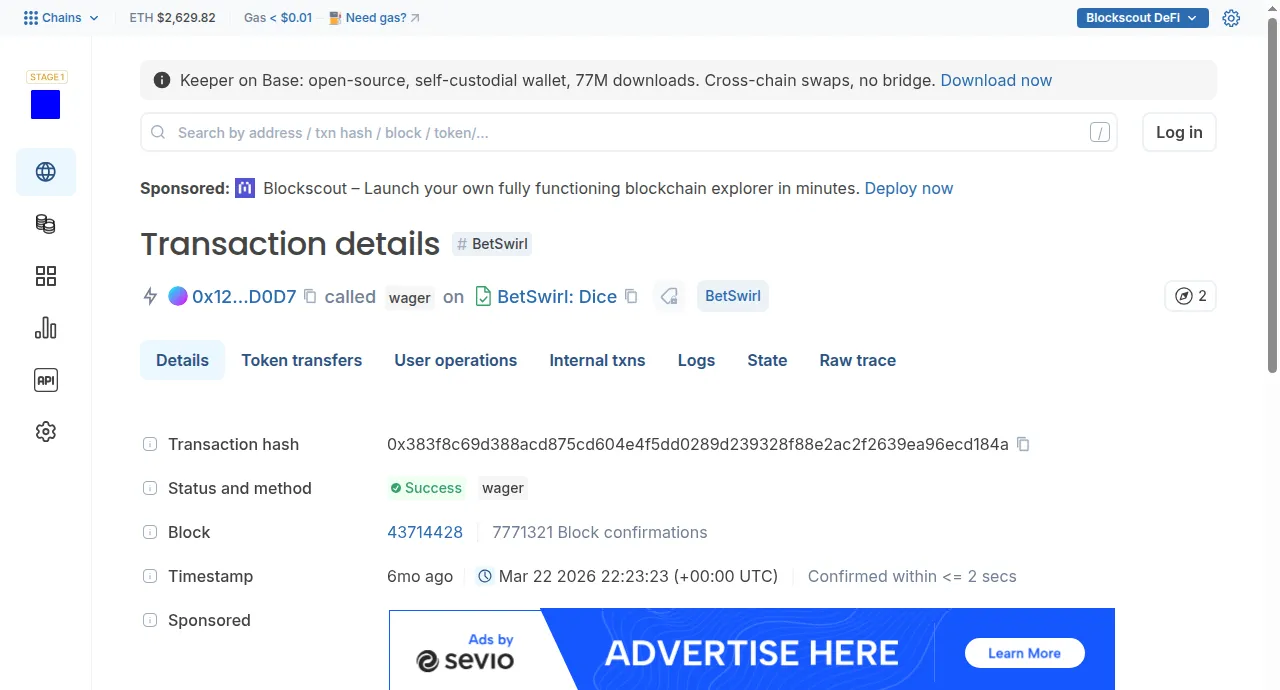
This is a Dice bet on Base, placed on 22 March 2026 on BetSwirl, which has since wound down. Reading it top to bottom:
- From: a wallet address. Not an account name, not an email. The bet came straight from the player's wallet.
- Method:
wager, on the Dice contract. That is the function that takes a bet. - Value: 0.000012 ETH sent with the call. On a contract casino part of what you send can be the fee for the random number, not only the stake; the transaction's logs show the split.
- Status: success, confirmed in its block.
- Gas: 403,875 units used, for a fee of 0.0000024 ETH.
The payout, if there was one, came from the contract back to the same wallet. No one at the platform typed anything. If the platform disappears, as this one did, the transaction is still there.
Four ways the other side is funded
Every bet needs someone on the other side. On-chain platforms solve that in four ways, and the model decides who carries the risk and who takes the fee.
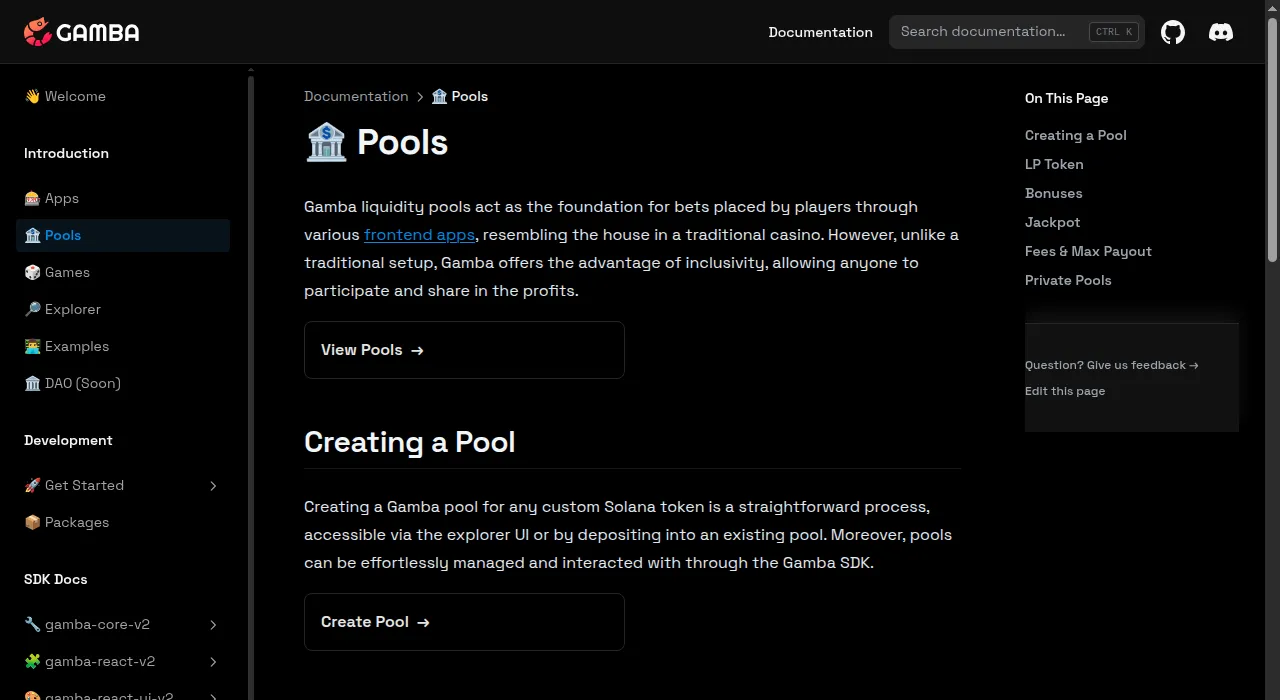
A liquidity pool. Azuro, Overtime and Gamba use pools. Liquidity providers deposit funds; the pool takes the other side of every bet; the providers earn when players lose and lose when players win. Azuro splits its revenue 70% to apps, 20% to liquidity providers and 10% to data providers. Overtime's pools hold USDC, ETH, wBTC and cbBTC. On Gamba anyone can open a pool for any Solana token.
A shared bankroll. WINR runs one bankroll on Arbitrum for every game built on it. Liquidity providers own it; results settle in epochs of about five minutes rather than bet by bet. Its risk rules cap any single payout at 2% of the bankroll and stop the bankroll to withdrawals only after a 10% drawdown.
Peer-to-peer escrow. SX Bet has no house. A maker posts odds, a taker accepts, and both stakes lock in an escrow contract for the match. When it is graded, the contract pays the winner. The exchange takes 1% of the taker's net profit.
A bank contract. BetSwirl used a bank contract per chain, shared by all its games, with each game in its own contract. Clean and simple, and its contracts outlived its app.
What “settled on-chain” doesn't cover
On-chain settlement tells you the payout followed the contract's rules. It doesn't tell you the input was fair. For casino games, that is the random number; for sports, it is the result. A contract can settle perfectly on a bad input. That is why settlement and outcome are two separate checks in our score, and why randomness has its own page: where randomness comes from.
It also doesn't cover what runs off-chain on the same site. Dexsport settles its sportsbook from an on-chain pool, while its 7,500 casino games are ordinary provider titles run off-chain. JustBet settles on Arbitrum, but you reach your balance through an account.
What it costs
Each bet is a transaction, so each bet pays gas in the chain's own coin, on top of the house edge or platform fee. The Base bet above paid 0.0000024 ETH. A comparable Dice bet on Arbitrum paid 0.0000064 ETH and one on Polygon paid 0.0094 POL. None of the live platforms runs games on Ethereum mainnet, where the same call would cost many times more. The costs of the model show up elsewhere too:
| Platform | Settlement model | Platform fee |
|---|---|---|
| Bookmaker.xyz (Azuro) | Liquidity pool, per bet | Margin in the odds; revenue split 70/20/10 |
| Overtime | Liquidity pool; sportsbook wins claimed | 2% sportsbook protocol fee; casino edge capped, e.g. 5% on dice |
| SX Bet | P2P escrow per match | 0% maker, 1% taker, 5% on parlay profit |
| Gamba | Pool per token | Front-end fees, rates set by each site |
| JustBet (WINR) | Shared bankroll, ~5-minute epochs | Game edge; creators take 10–15% of gross loss |
How settlement shows up in our score
Full on-chain settlement earns the settlement point in how we score. Dexsport gets half, because its casino side is off-chain. Account casinos get nothing: the result on screen is their database. The full picture of who keeps your money between bets is in who holds the money, and the platforms side by side are on the decentralized casinos ranking.